Solar Panels in Alicante
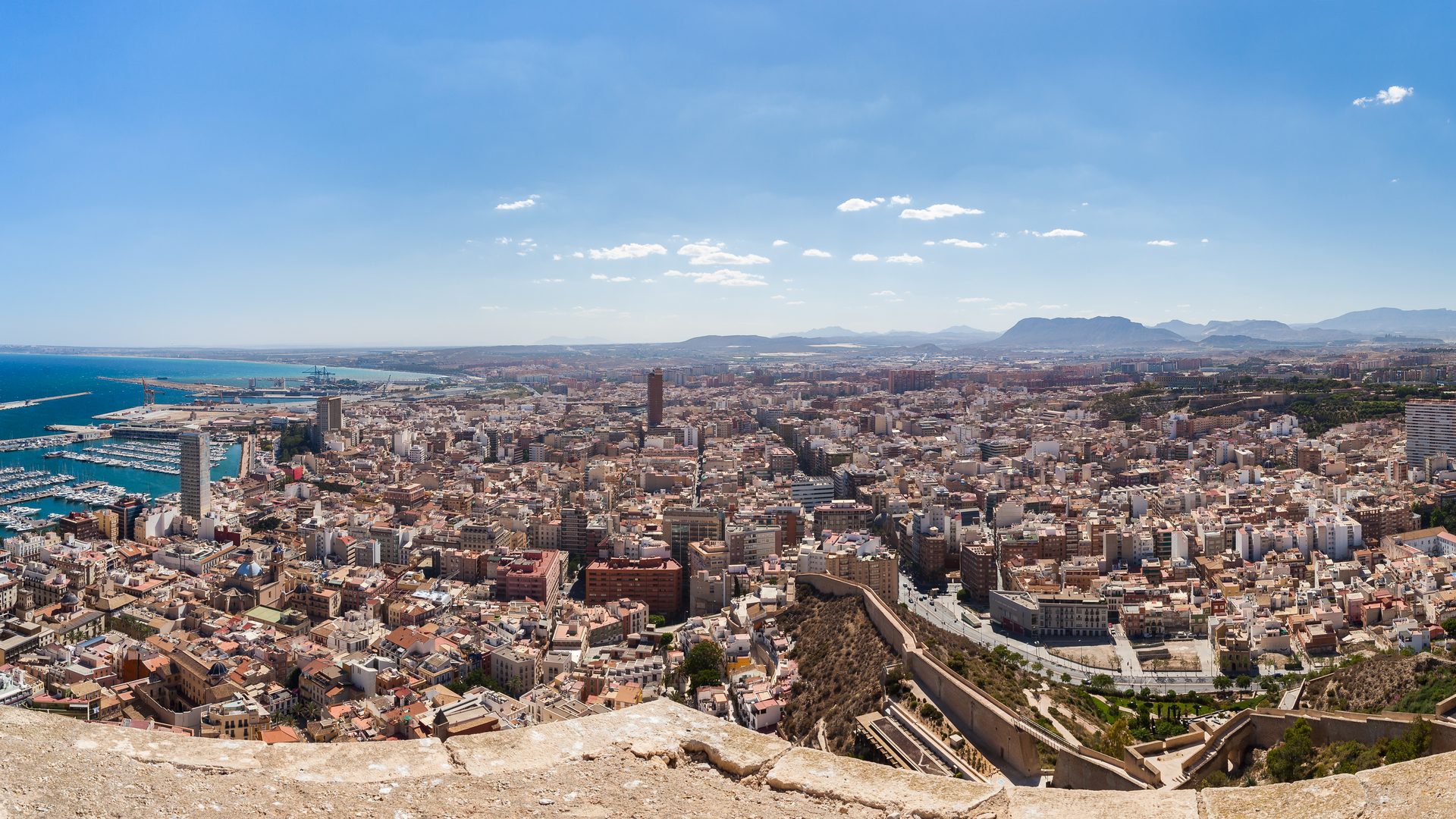
Alicante is a full city market rather than a single urbanisation: apartment blocks in the centre, detached houses in Vistahermosa, Albufereta, Cabo de las Huertas, Playa de San Juan and Santa Faz, and villa plots inland towards Rebolledo and Aigües. We size each system for the specific property type and handle the municipal and grid paperwork.
Sun & Climate
Alicante has the dry, sunny Mediterranean climate of the southern Costa Blanca, with a long cooling season that pushes electricity use into daylight hours. Roofs here vary far more than in a villa-only town — flat azoteas, tiled pitches and shared community roofs all behave differently. We measure orientation, tilt and shading on your actual roof instead of applying an average yield figure.
City homes and villa suburbs
In the seafront and hillside districts the typical load is air conditioning across several rooms, a pool pump in the villa zones and increasingly an EV wallbox in the garage. Those are daytime and evening loads, so we look at whether a battery is worth adding rather than assuming it. For homes inside a comunidad de propietarios we also check what the community statutes and roof-use rules allow before designing anything.
Tax and permit paperwork in Alicante
Curious about the numbers? See full solar panel cost for Costa Blanca villas — transparent packages from €4,500 with installation, permits and 25-year warranty included.
Alicante district by district: what the roof decides
Alicante is not one building type. Within the same city we quote flat community azoteas, detached houses with private roofs and hillside plots with sea views — and each of those changes the mounting system, the usable area and who has to approve the work.
- Vistahermosa. Mostly detached and semi-detached houses with private roofs and garages. Typical profile: multi-room air conditioning, a pool pump and space for an EV wallbox, so the system is usually sized around daytime self-consumption rather than a large battery.
- Albufereta. A mix of low-rise blocks and single-family homes on sloping ground. Terrain and neighbouring buildings can shade the lower plots in the early morning or late afternoon, so we measure the real shading curve before fixing the panel count.
- Cabo de las Huertas. Detached villas close to the sea. Exposure is open and production is good, but salt-laden air argues for corrosion-resistant mounting hardware and careful cable routing.
- Playa de San Juan. Mainly apartment buildings and gated developments with a shared flat roof. Here the technical question is secondary — first we establish who owns the azotea and what the community can authorise. Note this is a district of Alicante city, not the neighbouring municipality of Sant Joan d'Alacant.
- Santa Faz and the northern edge. Lower-density housing and older properties where roof structure and existing electrical installation need checking before anything is designed.
- El Rebolledo and the inland plots. Larger plots, often with ample flat or lightly pitched roof area and few shading obstacles — the situations where an oversized, well-oriented array is realistic.
We do not apply an average yield figure per district. Orientation, tilt, usable area, access for installation and shading are measured on your own roof during the free site visit.
Shared roofs, apartments and the comunidad de propietarios
In Alicante city a large share of homes sit inside a comunidad de propietarios, where the azotea is normally a common element. That changes the decision path, not the technology.
- Individual installation on a common roof: possible with the community's authorisation, subject to what the statutes and the roof-use rules say. We review those documents before designing anything.
- Collective self-consumption (autoconsumo colectivo): one installation shared between several homes. Spanish rules define which consumers can be associated with it — same low-voltage network from the same transformer, under 500 m between metering points, or the same cadastral reference in its first 14 digits (RD 244/2019, art. 3.g).
- Community-only installation: panels supplying the common services of the building (lift, lighting, pumps), which is often the simplest first step and the easiest to approve.
- Under the Horizontal Property Act, the installation of renewable-energy systems in a building can be approved at the request of any owner by one third of the owners representing one third of the participation quotas, and the cost cannot be charged to owners who did not vote in favour (Ley 49/1960, art. 17.1).
We quote the rule, we do not act as your legal adviser: the final decision depends on your building's statutes and on the resolution actually adopted at the owners' meeting. We prepare the technical documentation the meeting needs to vote on.
Ley de Propiedad Horizontal (BOE) · RD 244/2019, self-consumption (BOE)
FAQs — Alicante
Related guides for villa owners
Homeowners in the Alicante area
"The system was sized around our real bill rather than a standard package, and the municipal and grid paperwork was handled for us from start to finish."
Homeowner, Alicante area
Alicante